
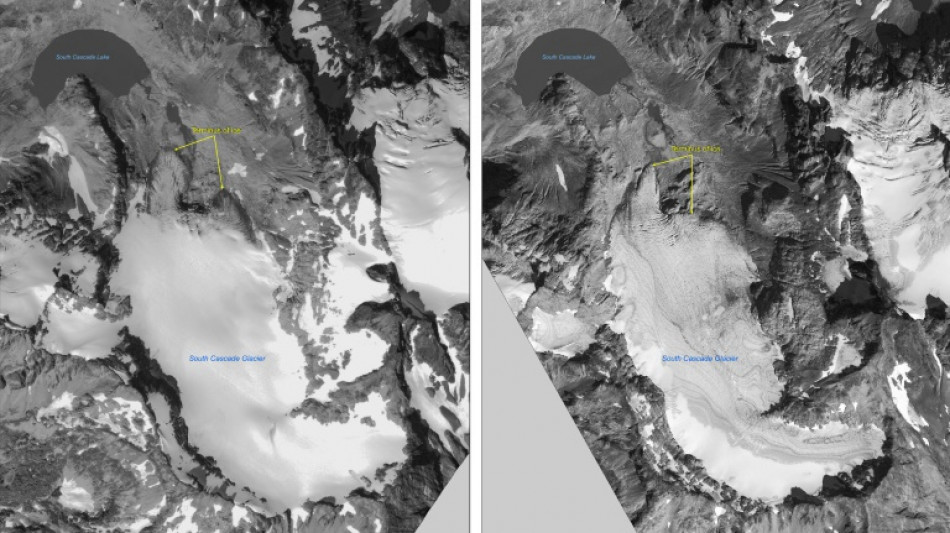
In US Northwest, South Cascade is where glacier science grew up / Photo: HANDOUT - GETTY IMAGES NORTH AMERICA/AFP/File
For nearly 70 years scientists have been probing, measuring, drilling and generally getting to know South Cascade Glacier in the US Northwest, developing and honing skills now used worldwide.
Generations of glaciologists have studied the slow-moving ice mass in Washington state, which is one of five so-called "benchmark" US glaciers, keeping tabs on how they are changing as human activity warms the Earth.
While glaciers have been studied in Europe since at least the 19th century, what scientists learned here has been invaluable.
"A lot of the scientific methods that we use to measure glaciers were developed here," said Andrew Fountain, professor emeritus at Portland State University, who specializes in glaciers and climate change.
That includes the use of ice radar, which allowed researchers to see just how thick the ice is in a spot where a glacier has probably existed for upwards of a million years.
- Ideal for studying -
South Cascade Glacier sits in a basin at the head of the South Fork of the Cascade river, which flows down ultimately into Puget Sound.
The size of the basin -- more than 2 square miles (over 6 square kilometers) -- along with its straightforward geometry made it ideal to study for scientists wanting to know how these dynamic bodies are faring in the changing world.
A glacier is a perennial accumulation of snow and ice that is always on the move, abrading the rocks underneath and -- over a long enough period of time -- carving valleys.
Measurements began at the site in 1958, according to the US Geological Survey, the government body that studies the natural environment.
The following year, the USGS began what is known as a "continuous mass balance" measurement project that keeps a running tally of streamflow runoff, precipitation, air temperature, barometric pressure, snow thickness and density, ice ablation, surface speed and surface altitude.
- Retreating -
The data collected here, as well as from the four other benchmark glaciers -- three in Alaska and one in Montana -- provides a continuous record, capturing their seasonal variations and their year-to-year changes.
Over nearly seven decades, glaciologists have been able "to track how the glacier is responding to climate."
And what they are seeing is not good, says Fountain.
"As you can imagine, it's been retreating like crazy" and is now about half the size it was when measurements started.
With a very complete record of the conditions, it's clear that the rising temperatures of the industrial age are to blame, said Fountain.
A warmer atmosphere reduces the amount of precipitation that falls as snow, and increases the ambient air temperature so what snow does fall, doesn't hang around.
While people may find it difficult to discern any long-term trends from the wildly differing amounts of snow a region can experience from year to year, a shrinking glacier is an obvious sign that the balance of nature is off.
"We can understand very viscerally that the climate is warming," he said.
Since President Donald Trump -- a climate change skeptic -- came to power, he and billionaire adviser Elon Musk have set about slashing government spending, eliminating tens of thousands of government jobs, including scientists.
This week, researchers at the Environmental Protection Agency -- which tackles environmental issues including pollution, clean water and climate change -- were put in the firing line.
For Fountain, whatever the reason a government has for diminishing the work of scientists, they should not be ignored.
About two percent of the world's water is stored in glaciers, and if they all melt, it will run eventually into the oceans, further raising sea levels and imperiling human settlements along tens of thousands of miles (kilometers) of coastlines worldwide.
That, amongst other reasons, is why the science of glaciology that came of age at South Cascade Glacier is invaluable, said Fountain.
"Just because we don't want to hear a message doesn't mean it isn't happening," he said.
C.Masood--DT


