Dubai Telegraph - Private jet carbon emissions soar 46%: study

EUR -
AED 4.315152
AFN 77.708509
ALL 96.852138
AMD 448.491142
ANG 2.103707
AOA 1077.46608
ARS 1692.867744
AUD 1.766731
AWG 2.114983
AZN 1.996065
BAM 1.958827
BBD 2.365606
BDT 143.531799
BGN 1.957646
BHD 0.442923
BIF 3471.553207
BMD 1.174991
BND 1.516883
BOB 8.115541
BRL 6.345419
BSD 1.17454
BTN 106.215586
BWP 15.56238
BYN 3.462451
BYR 23029.817846
BZD 2.36217
CAD 1.617428
CDF 2631.978985
CHF 0.93526
CLF 0.027299
CLP 1070.885484
CNY 8.288974
CNH 8.27372
COP 4466.84467
CRC 587.522896
CUC 1.174991
CUP 31.137254
CVE 110.435656
CZK 24.285177
DJF 209.15766
DKK 7.470444
DOP 74.667289
DZD 152.34334
EGP 55.789738
ERN 17.624861
ETB 183.52108
FJD 2.648192
FKP 0.879185
GBP 0.877671
GEL 3.168367
GGP 0.879185
GHS 13.482835
GIP 0.879185
GMD 85.774311
GNF 10213.261358
GTQ 8.995863
GYD 245.719709
HKD 9.144171
HNL 30.922442
HRK 7.532747
HTG 153.951832
HUF 385.151393
IDR 19592.088787
ILS 3.766621
IMP 0.879185
INR 106.613135
IQD 1538.577555
IRR 49493.544354
ISK 148.41283
JEP 0.879185
JMD 188.054601
JOD 0.833059
JPY 182.086549
KES 151.515079
KGS 102.752804
KHR 4702.386633
KMF 492.911492
KPW 1057.491268
KRW 1720.480396
KWD 0.36051
KYD 0.978813
KZT 612.546565
LAK 25462.346819
LBP 105176.728999
LKR 362.920819
LRD 207.301224
LSL 19.815521
LTL 3.469442
LVL 0.710741
LYD 6.379995
MAD 10.805297
MDL 19.854766
MGA 5203.151106
MKD 61.58937
MMK 2466.617904
MNT 4166.358748
MOP 9.418054
MRU 47.004836
MUR 53.990968
MVR 18.088629
MWK 2036.690621
MXN 21.126092
MYR 4.808648
MZN 75.093803
NAD 19.815521
NGN 1705.53442
NIO 43.227904
NOK 11.911281
NPR 169.94896
NZD 2.027652
OMR 0.451782
PAB 1.174515
PEN 3.954311
PGK 5.062068
PHP 69.231624
PKR 329.162758
PLN 4.221642
PYG 7889.359242
QAR 4.280496
RON 5.094291
RSD 117.388641
RUB 92.967943
RWF 1709.478019
SAR 4.40866
SBD 9.607607
SCR 17.223335
SDG 706.756952
SEK 10.910905
SGD 1.51451
SHP 0.881547
SLE 28.346692
SLL 24638.971924
SOS 670.04968
SRD 45.293589
STD 24319.935326
STN 24.534259
SVC 10.276881
SYP 12991.498391
SZL 19.808863
THB 36.931722
TJS 10.793679
TMT 4.124217
TND 3.433491
TOP 2.829096
TRY 50.173396
TTD 7.970316
TWD 36.798371
TZS 2916.912694
UAH 49.627044
UGX 4174.450755
USD 1.174991
UYU 46.090635
UZS 14149.865707
VES 314.239221
VND 30925.755393
VUV 142.323844
WST 3.261166
XAF 656.986216
XAG 0.018396
XAU 0.000271
XCD 3.175471
XCG 2.116771
XDR 0.81708
XOF 656.986216
XPF 119.331742
YER 280.241445
ZAR 19.712468
ZMK 10576.317779
ZMW 27.102111
ZWL 378.346528
  • SCS

    0.0200

    16.14

    +0.12%

  • BCE

    0.1461

    23.54

    +0.62%

  • BCC

    -0.5500

    75.96

    -0.72%

  • NGG

    0.8900

    75.82

    +1.17%

  • GSK

    0.4600

    49.27

    +0.93%

  • RBGPF

    -3.4900

    77.68

    -4.49%

  • RIO

    -0.1300

    75.53

    -0.17%

  • CMSC

    -0.0100

    23.29

    -0.04%

  • JRI

    0.0085

    13.575

    +0.06%

  • RYCEF

    0.2200

    14.82

    +1.48%

  • CMSD

    0.0750

    23.325

    +0.32%

  • BTI

    0.5200

    57.62

    +0.9%

  • AZN

    1.3000

    91.13

    +1.43%

  • VOD

    0.1450

    12.735

    +1.14%

  • RELX

    0.9450

    41.325

    +2.29%

  • BP

    -0.0100

    35.25

    -0.03%

Private jet carbon emissions soar 46%: study
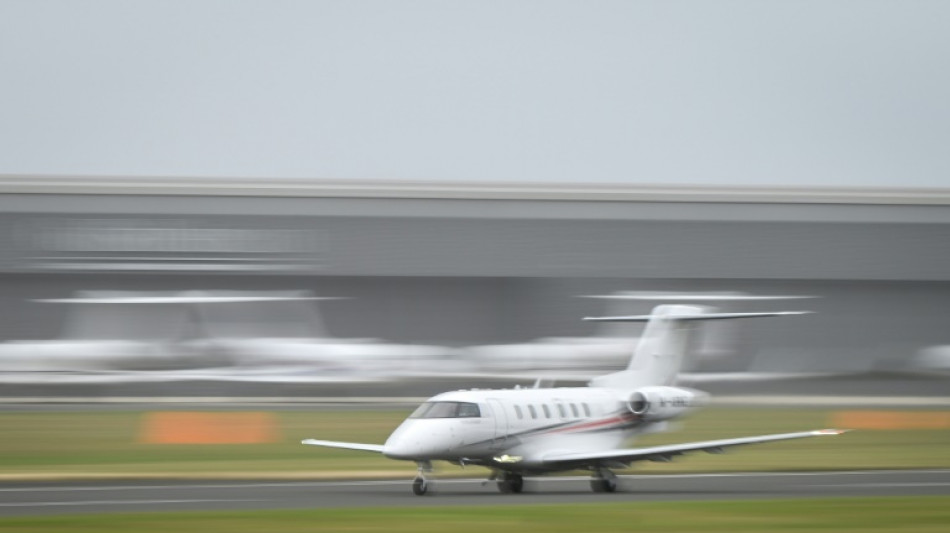
Private jet carbon emissions soar 46%: study / Photo: JUSTIN TALLIS - AFP

Private jet carbon emissions soar 46%: study

The carbon footprint from private jet travel grew 46 percent between 2019 and 2023 and will keep rising unless the ultra-luxury industry is regulated, according to new research published Thursday.

Text size:

Carbon dioxide emissions from private aviation peaked over the European summer and around major global events like the World Cup, Cannes Film Festival and UN climate summits, the study found.

The transport of choice for the rich and famous, private jets are the most energy-intense form of flying and the industry has long been a target of climate protesters.

Private aviation was responsible for 15.6 million tonnes of CO2 emissions in 2023, wrote the study's authors from Swedish, Danish and German universities.

This represented less than two percent of commercial aviation's overall carbon emissions.

But private jets cater to just 256,000 people -- about 0.003 percent of the world's adult population -- meaning significantly higher emissions per passenger than commercial travel.

Researchers assessed flight tracker data from roughly 18.7 million individual charters flown between 2019 and 2023 representing the vast majority of global private aviation.

They found roughly half these trips were less than 500 kilometres (310 miles) and many were empty, en route to pickup or undertaking a delivery.

They also noted that private jets on very short trips "in many instances appear to replace cars for time gains or convenience".

"The analysis shows that individuals using PA (private aviation) emit disproportionally more than an average human," said the study published in the peer-reviewed journal Communications Earth & Environment.

Around two-thirds of the world's private jets are based in the United States, and the average passenger has a personal net worth of $123 million.

In 2023, considerable private jet traffic was associated with the Super Bowl, the World Economic Forum in Davos and the COP28 climate conference in Dubai.

Such gala events can attract "hundreds of individual flights" that generate "considerable emissions", the study said.

There was also "a clear seasonal trend of visitation peaking in summer" in luxury coastal locations like Ibiza and Nice, with journeys clustered around weekends.

The private jet industry is forecast to grow, with predictions the current fleet of 26,000 aircraft could grow roughly one-third by 2033.

This means private aviation will become increasingly important as a source of CO2 emissions in relative and absolute terms, the authors said.

"As sustainable aviation fuel use remains limited, and a majority of private aircraft owners do not plan to use it in the near future, it will be necessary to regulate the sector."

Private air travel "illustrates the policy conundrum of addressing the role of the affluent, as policymakers are reluctant to focus on the wealthy and powerful", the study added.

H.El-Qemzy--DT