Dubai Telegraph - Homo erectus, not sapiens, first humans to survive desert: study

EUR -
AED 4.309445
AFN 77.526287
ALL 96.608144
AMD 447.374631
ANG 2.10092
AOA 1076.03909
ARS 1690.625162
AUD 1.765924
AWG 2.112182
AZN 1.996955
BAM 1.953942
BBD 2.359656
BDT 143.173869
BGN 1.953942
BHD 0.440281
BIF 3462.807524
BMD 1.173434
BND 1.513061
BOB 8.095303
BRL 6.359657
BSD 1.171586
BTN 105.950261
BWP 15.52324
BYN 3.453816
BYR 22999.311998
BZD 2.35626
CAD 1.615631
CDF 2628.492315
CHF 0.934505
CLF 0.027227
CLP 1068.11854
CNY 8.277989
CNH 8.2773
COP 4461.957521
CRC 586.042784
CUC 1.173434
CUP 31.096009
CVE 110.160258
CZK 24.270261
DJF 208.631631
DKK 7.469431
DOP 74.479184
DZD 151.466984
EGP 55.571966
ERN 17.601514
ETB 183.058746
FJD 2.66581
FKP 0.877152
GBP 0.878151
GEL 3.157157
GGP 0.877152
GHS 13.449212
GIP 0.877152
GMD 85.661103
GNF 10189.311889
GTQ 8.973468
GYD 245.10695
HKD 9.134945
HNL 30.844673
HRK 7.533212
HTG 153.56399
HUF 384.919306
IDR 19518.612548
ILS 3.781738
IMP 0.877152
INR 106.294956
IQD 1534.740751
IRR 49427.984373
ISK 148.323015
JEP 0.877152
JMD 187.581645
JOD 0.831948
JPY 182.987099
KES 151.076355
KGS 102.61686
KHR 4690.540182
KMF 492.180259
KPW 1056.08658
KRW 1730.70933
KWD 0.359892
KYD 0.976372
KZT 611.019036
LAK 25398.85049
LBP 104914.446177
LKR 362.015791
LRD 206.783388
LSL 19.766106
LTL 3.464846
LVL 0.709798
LYD 6.363949
MAD 10.778352
MDL 19.805169
MGA 5190.065228
MKD 61.491533
MMK 2464.003
MNT 4160.966054
MOP 9.394568
MRU 46.88642
MUR 53.88439
MVR 18.066702
MWK 2031.568362
MXN 21.132296
MYR 4.807913
MZN 74.994631
NAD 19.766106
NGN 1704.495728
NIO 43.119002
NOK 11.880441
NPR 169.520818
NZD 2.023359
OMR 0.449043
PAB 1.171586
PEN 3.94445
PGK 5.050198
PHP 69.3676
PKR 328.333517
PLN 4.223372
PYG 7869.517575
QAR 4.26984
RON 5.087892
RSD 117.2685
RUB 93.580543
RWF 1705.178697
SAR 4.402964
SBD 9.594881
SCR 17.633179
SDG 705.818659
SEK 10.878005
SGD 1.515954
SHP 0.88038
SLE 28.309124
SLL 24606.334552
SOS 668.364512
SRD 45.233557
STD 24287.720558
STN 24.476727
SVC 10.251253
SYP 12974.451022
SZL 19.759213
THB 37.074612
TJS 10.766763
TMT 4.118754
TND 3.424944
TOP 2.825349
TRY 50.102775
TTD 7.950441
TWD 36.769686
TZS 2899.642987
UAH 49.502233
UGX 4164.040784
USD 1.173434
UYU 45.976285
UZS 14114.5797
VES 313.822972
VND 30868.362317
VUV 141.61592
WST 3.256846
XAF 655.333901
XAG 0.018937
XAU 0.000273
XCD 3.171265
XCG 2.111492
XDR 0.815025
XOF 655.333901
XPF 119.331742
YER 279.827953
ZAR 19.806884
ZMK 10562.316454
ZMW 27.034295
ZWL 377.845361
  • SCS

    0.0200

    16.14

    +0.12%

  • RBGPF

    0.0000

    81.17

    0%

  • BCC

    0.2500

    76.51

    +0.33%

  • CMSD

    -0.1500

    23.25

    -0.65%

  • NGG

    0.2400

    74.93

    +0.32%

  • GSK

    -0.0700

    48.81

    -0.14%

  • RIO

    -1.0800

    75.66

    -1.43%

  • CMSC

    -0.1300

    23.3

    -0.56%

  • BP

    -0.2700

    35.26

    -0.77%

  • BCE

    0.3100

    23.71

    +1.31%

  • RELX

    0.1000

    40.38

    +0.25%

  • BTI

    -1.2700

    57.1

    -2.22%

  • JRI

    -0.0200

    13.7

    -0.15%

  • VOD

    0.0500

    12.59

    +0.4%

  • AZN

    -0.4600

    89.83

    -0.51%

  • RYCEF

    -0.2500

    14.6

    -1.71%

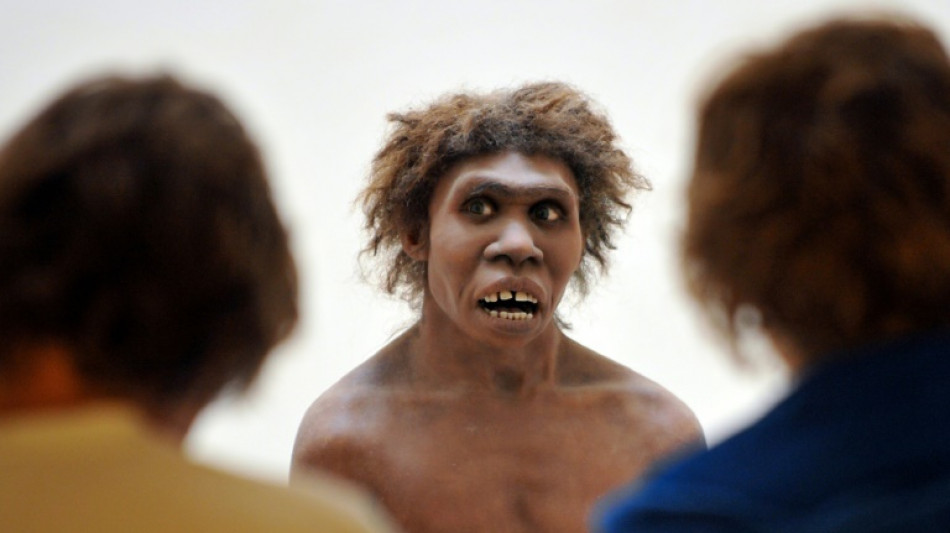
Homo erectus, not sapiens, first humans to survive desert: study
Homo erectus, not sapiens, first humans to survive desert: study / Photo: PIERRE ANDRIEU - AFP/File

Homo erectus, not sapiens, first humans to survive desert: study

Our ancestor Homo erectus was able to survive punishingly hot and dry desert more than a million years ago, according to a new study that casts doubt on the idea that Homo sapiens were the first humans capable of living in such hostile terrain.

Text size:

The moment when the first members of the extended human family called hominins adapted to life in desert or tropical forests marks "a turning point in the history of human survival and expansion in extreme environments," lead study author Julio Mercader Florin of the University of Calgary told AFP.

Scientists have long thought that only Homo sapiens, who first appeared around 300,000 years ago, were capable of living sustainably in such inhospitable regions.

The first hominins to have split off from the other great apes were believed to be limited to less hostile ecosystems, such as forest, grasslands and wetlands.

One of the world's most important prehistoric sites, Olduvai Gorge in modern-day Tanzania, was thought to home to those easier types of landscapes.

But this steep ravine in East Africa's Great Rift Valley, which has played a key role in the understanding of human evolution, was actually a desert steppe, according to the study published in the journal Communications Earth & Environment on Thursday.

After collecting archaeological, geological and palaeoclimatic data, the international team of researchers were able to reconstruct the gorge's ecosystem over the years.

Fossilised pollen of the Ephedra shrub -- which commonly lives in arid areas -- as well as traces of past wildfires and signs in the soil show there was an extreme drought in the area between one and 1.2 million years ago.

- Homo erectus: underestimated? -

Evidence collected from the Engaji Nanyori site in the gorge suggests that Homo erectus adapted to this hostile environment "by focusing on ecological focal points such as river confluences where water and food resources were more predictable", Mercader Florin said.

"Their ability to repeatedly exploit these focal points... and adapt their behaviours to extreme environments demonstrates a higher level of resilience and strategic planning than previously assumed."

Specialised tools found at the site, such as hand axes, scrapers and cleavers, showed that Homo erectus had also worked out how to process animal carcasses.

The bones of animals such as cows, hippopotamuses, crocodiles and antelopes also had cut marks, indicating they had been skinned and had their bone marrow extracted.

"This suggests they optimised their resource use to adapt to the challenges of arid environments, where resources were scarce and needed to be exploited fully," Mercader Florin said.

"Our findings show that Homo erectus was capable of surviving long term in extreme environments characterised by low density of food resources, navigational challenges, very low/very high plant life, temperature/humidity extremes, and the need for high mobility," he added.

"This adaptability expands Homo erectus's potential range into the Saharo-Sindian region across Africa and into similar environments in Asia."

F.Saeed--DT